Wisdom teeth are the last molars to come through, usually between 17 and 25. Not every wisdom tooth needs to come out. Your dentist checks them with an exam and X-rays. Removals, including surgical extractions, can be done at our Sandgate clinic. Some cases, such as teeth very close to a nerve, may be referred to an oral surgeon.
Book online (opens in a new tab) Rather talk first? Call (07) 3269 625212 Lagoon St, Sandgate QLD 4017 · Open Saturday mornings, 8:00AM to 12:00PM · Happy gas available, charged separately
Wisdom teeth are the last molars to develop, usually emerging in the late teens or early twenties. For younger patients, see our guide to wisdom teeth for teenagers. While some people's wisdom teeth come through without any issues, many experience pain, crowding or infection when there isn't enough room in the jaw for them to erupt properly. At Sandgate Family Dental, our experienced team provides wisdom teeth assessments, monitoring and removal for patients of all ages. If your wisdom teeth are causing discomfort or your dentist has identified a potential problem at a routine check-up, we'll explain your options clearly and help you make an informed decision.
Wisdom teeth (also called third molars) are the four molars located at the very back of your mouth — one in each corner. They're the last permanent teeth to come through, typically appearing between the ages of 17 and 25, though some people develop them earlier or later, and some don't develop them at all.
At Sandgate Family Dental, wisdom teeth assessments and removals are carried out by both our dentists, Dr Nina Stallman and Dr Nima Kancherla, for patients across Sandgate and the north Brisbane bayside. Dr Nima does most complex cases, including surgical extractions. Where removal is straightforward it can often be done in the chair, and we explain your options before any treatment.
In many cases, the jaw doesn't have enough space to accommodate these extra molars. When this happens, wisdom teeth can become impacted — meaning they're trapped below the gumline or growing at an angle. Impacted or partially erupted wisdom teeth can lead to a range of problems, which is why your dentist monitors their development at your regular dental check-ups and may recommend removal if concerns arise.
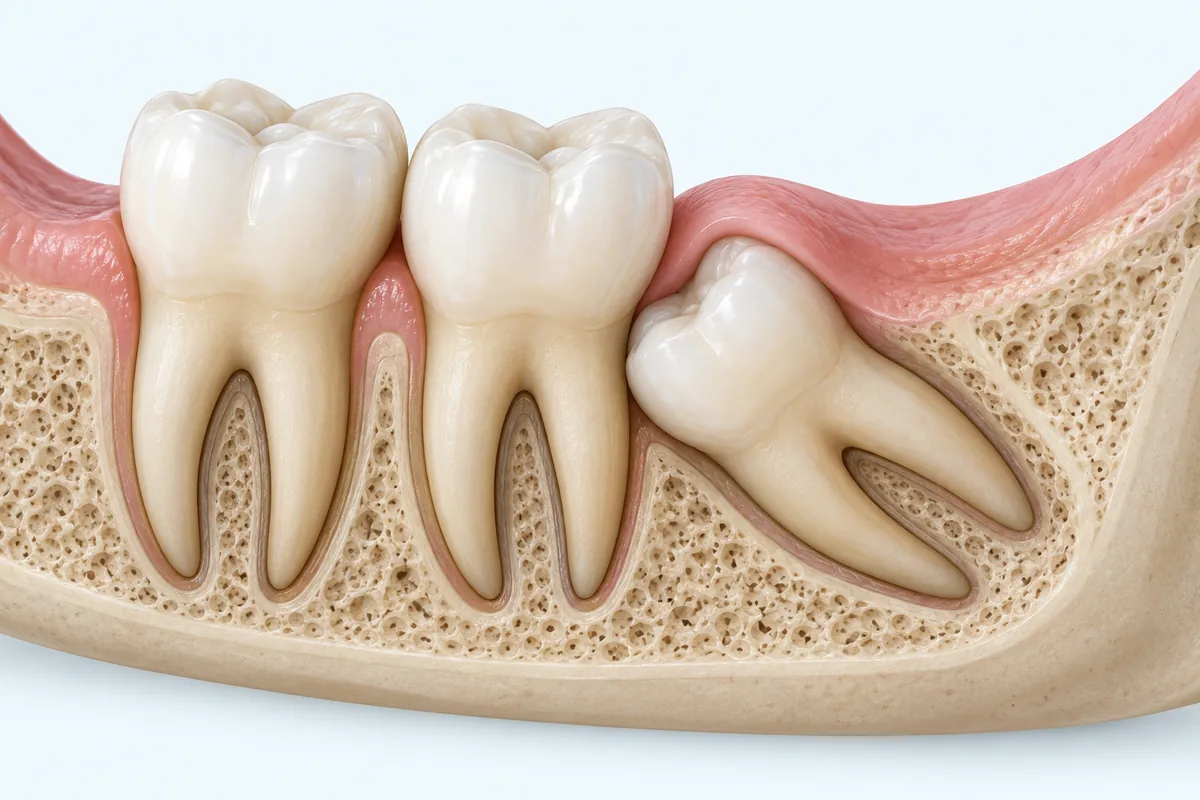
Not every wisdom tooth needs to come out. If your wisdom teeth have erupted fully, are positioned correctly, are healthy, and can be cleaned effectively, your dentist may simply monitor them over time.
However, removal may be recommended if your wisdom teeth are:
Your dentist will assess the position and condition of your wisdom teeth using a clinical examination and X-rays (including panoramic X-rays that show the full jaw), and will only recommend removal when there's a clear clinical reason to do so.
Some wisdom tooth issues develop gradually, while others can come on suddenly. Signs that your wisdom teeth may need attention include:
If you're experiencing any of these symptoms, it's worth having things assessed. If the pain is severe, you have significant swelling, or you suspect an infection, visit our emergency dental page for urgent care options.
At Sandgate Family Dental, we provide wisdom teeth assessments and extractions, including surgical extractions, at our Sandgate clinic. Some cases, such as teeth very close to a nerve, may be referred to an oral surgeon.
Recovery after a wisdom tooth extraction varies depending on the complexity of the procedure, but you may feel significantly better within a few days.
Some swelling, mild discomfort and light bleeding are normal in the first day or two. Applying a cold pack to the outside of your cheek (20 minutes on, 20 minutes off) can help manage swelling. Rest as much as possible and avoid strenuous physical activity. Stick to soft foods and lukewarm or cool drinks — avoid hot foods and beverages, alcohol, and using a straw, as suction can dislodge the blood clot forming in the socket.
Over-the-counter pain relief (such as paracetamol or ibuprofen, as directed by your dentist) is usually sufficient to manage discomfort; ask your dentist or pharmacist which is suitable for you. Your dentist may also prescribe antibiotics if there's an infection or a high risk of one developing. Take all medications as directed.
Gently rinse your mouth with warm salt water (half a teaspoon of salt in a glass of warm water) starting from the day after the extraction. Avoid vigorous rinsing or spitting, as this can disturb the healing socket. Continue brushing your other teeth as normal, but be gentle around the extraction site.
You can usually return to work or school within one to three days, depending on the complexity of the extraction and how you're feeling. Full healing of the gum tissue typically takes a few weeks, and the underlying bone may take several months to fully remodel — though this usually happens without any noticeable discomfort.
Contact our clinic if you experience increasing pain after the first two to three days (rather than improving), persistent or heavy bleeding, significant swelling that worsens after 48 hours, fever, difficulty swallowing or breathing, or numbness that doesn't resolve. These may indicate a complication such as dry socket or infection, which can be treated promptly.
Once a wisdom tooth is removed, the socket heals naturally over time and generally doesn't need to be replaced, since wisdom teeth don't play a significant role in chewing or appearance.
However, if you've had other teeth extracted (not wisdom teeth), you may want to discuss replacement options with your dentist. Depending on the location and number of missing teeth, options may include a dental bridge, dental implant or denture. Your dentist can advise on the most appropriate approach for your situation.
Wisdom teeth assessments and extractions are generally covered under the general dental or surgical component of most health fund extras policies. The amount you receive back will depend on your level of cover, the complexity of the extraction, and your fund's fee schedule. Read more about health fund cover for wisdom teeth.
At Sandgate Family Dental, we process health fund claims on the spot using HICAPS, so you only need to pay the gap at the time of your visit. We are a preferred provider for HCF, nib, CBHS and HIF. Patients with these funds may receive higher rebates on their treatment. Visit our health funds page for more details.
We are also an approved provider for Smile.com.au, which offers members reduced fees on a range of treatments. Our team will always provide a clear cost estimate before proceeding. If you're a new patient, check out our new patient offer.
For patients under 18 whose families are eligible for the Child Dental Benefits Schedule (CDBS), some wisdom teeth treatments may be claimable under the scheme. Eligible children aged 0–17 can access up to $1,158 in dental benefits over a two-year period for eligible treatments. Our team can check eligibility and remaining benefits before your appointment. See our CDBS information page for more detail.
Tell us if you feel nervous. Your dentist explains your options before any treatment. You may feel some pressure and movement during removal. Some swelling and discomfort afterwards is common. Happy gas (inhalation sedation) is offered by both our dentists. It’s charged separately (ADA item 943). It isn’t suitable for everyone, so your dentist checks your medical history first.
Sandgate Family Dental, 12 Lagoon St, Sandgate QLD 4017 · (07) 3269 6252
Mon–Thurs 8:30AM–5:00PM · Fri 8:30AM–4:00PM · Sat 8:00AM–12:00PM
No. If your wisdom teeth have come through fully, are positioned correctly, are healthy, and can be cleaned effectively, they may not need to be removed. Your dentist will monitor their condition at your regular check-ups and only recommend removal when there's a clinical reason.
You may feel better within a few days after a straightforward extraction. Swelling and mild discomfort are common in the first 48 hours and usually improve steadily. Full healing of the gum tissue takes a few weeks. More complex surgical extractions may involve a slightly longer recovery period.
The procedure itself is carried out under local anaesthetic, so you shouldn't feel pain during the extraction. You may feel some pressure and movement. After the anaesthetic wears off, some discomfort and swelling is normal — this is usually well-managed with over-the-counter pain relief as directed by your dentist or pharmacist.
Impacted wisdom teeth are trapped under the gum or bone. Depending on the position and complexity, your dentist may be able to remove them in-chair at our Sandgate clinic. More deeply impacted teeth, or those close to nerves, may require referral to an oral surgeon for surgical removal under sedation or general anaesthetic. Your dentist will assess the situation and recommend the most appropriate approach.
Wisdom teeth typically develop between the ages of 17 and 25, so this is a common time for assessment. However, problems can occur at any age. Your dentist will monitor the development and position of your wisdom teeth through X-rays taken at routine check-ups and will advise if and when action is needed.
Wisdom teeth extractions are generally covered under the general dental or surgical component of health fund extras policies. The rebate amount depends on your level of cover and the complexity of the extraction. We process claims on the spot with HICAPS at our Sandgate clinic. Visit our health funds page for details on the funds we work with.
Sandgate Family Dental is located at 12 Lagoon St, Sandgate, with convenient access for patients throughout the North Brisbane bayside area. We're open six days a week, including Saturday mornings, making it easy to find a time that works for you.
We regularly care for patients from Sandgate, Shorncliffe, Brighton, Deagon, Boondall, Bracken Ridge, Taigum, Fitzgibbon, Clontarf, Woody Point, Margate and surrounding areas.
Whether you need a wisdom teeth assessment, are experiencing pain and need prompt attention, or want a second opinion on a recommendation — our team is here to help.
If you're experiencing pain, swelling or discomfort at the back of your jaw, our team can assess your wisdom teeth and explain your options.
Choose a time online, or call our Sandgate team.
Book online (opens in a new tab)Or call (07) 3269 6252