A dental crown is a custom-made cap that fits over the whole visible part of a tooth. It can protect a tooth that is cracked, worn, heavily filled or has had root canal treatment. It usually takes two appointments, about two weeks apart.
Book a consultation (opens in a new tab) Rather talk first? Call (07) 3269 625212 Lagoon St, Sandgate QLD 4017 · Open Saturday mornings, 8:00AM to 12:00PM · Happy gas available, charged separately
When a tooth is significantly damaged, weakened or heavily restored, a dental crown can provide the protection and strength it needs to function normally again. At Sandgate Family Dental, our experienced team provides custom-made dental crowns designed to match the shape, size and colour of your natural teeth. Whether you need a crown following root canal treatment, to restore a cracked tooth, or to replace a large failing filling, we'll guide you through the process step by step.
At Sandgate Family Dental, dental crowns are provided by our dentists Dr Nina and Dr Nima, for patients across Sandgate and the north Brisbane bayside. We explain when a crown is the right option and what each step involves.
A dental crown is a custom-made cap that fits over the entire visible portion of a tooth, restoring its shape, strength, size and appearance. It sits over the tooth like a protective shell, encasing the weakened structure beneath, and can help you bite and chew with confidence.
Crowns are one of the most commonly used restorations in restorative dentistry. They're crafted in a dental laboratory from your dentist's precise impressions or digital scans, so the finished crown is tailored to fit your mouth and blend with your surrounding teeth.
Once cemented in place, a well-fitted crown should look and feel like a natural tooth.
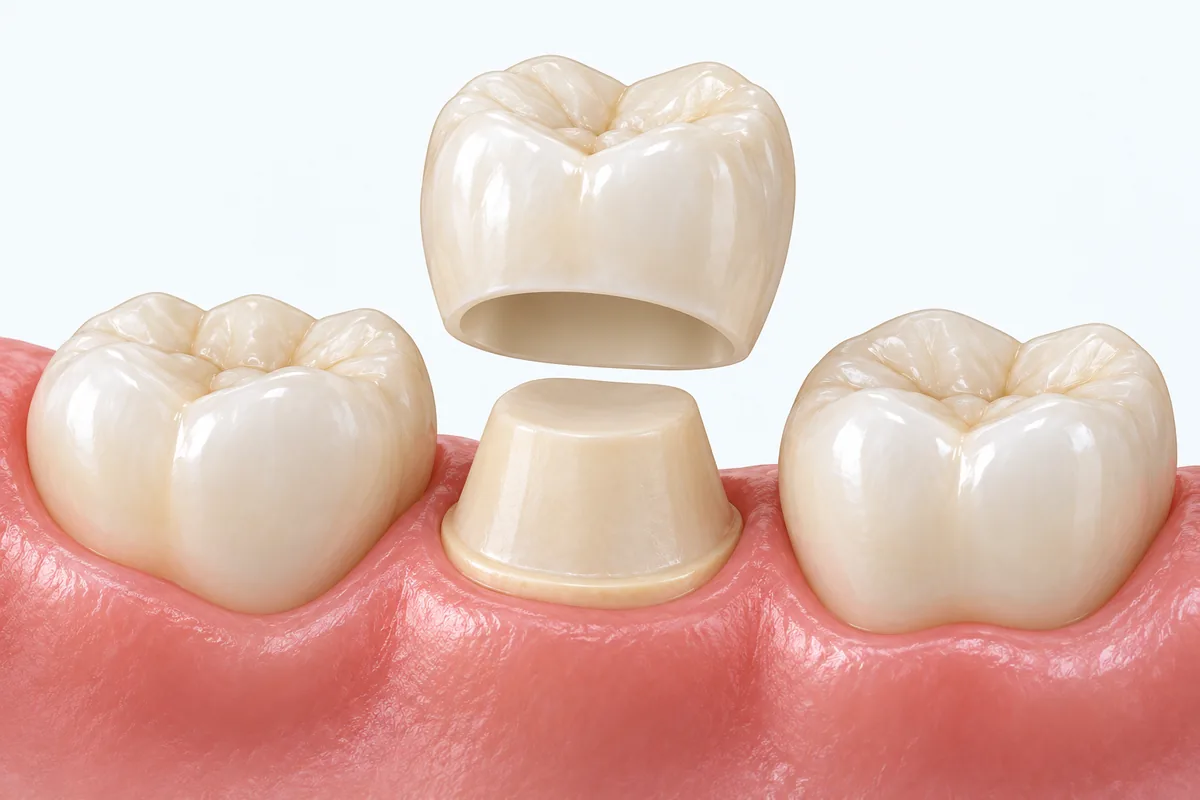
Your dentist may recommend a crown in a range of situations where a tooth needs more protection or support than a standard filling can provide.
A tooth that has undergone root canal therapy is often more brittle because the inner nerve tissue has been removed. A crown placed over the treated tooth helps protect it from fracturing and can help restore its function.
If a tooth has a significant crack, a large chip, or has been worn down over time — whether through grinding, clenching or general use — a crown can hold the remaining structure together and prevent further damage. If the crack occurred suddenly, our emergency dental team can assess the situation promptly.
When a filling becomes very large relative to the remaining tooth structure, or when an old filling cracks, leaks or falls out, a crown may be a more reliable long-term restoration. The crown covers and reinforces the entire tooth rather than just patching a portion of it.
Crowns are used as the anchor points (abutments) for a dental bridge. The crowns are fitted over the teeth on either side of the gap, supporting the artificial tooth (pontic) that fills the space.
In some cases, a crown may be recommended for cosmetic reasons — for example, to cover a severely discoloured, misshapen or undersized tooth. Where less preparation is needed, your dentist may also discuss alternatives such as dental bonding or veneers.
There are several crown materials available, and the right choice for you will depend on the location of the tooth, the amount of biting force it needs to withstand, and your aesthetic preferences.
All-porcelain or all-ceramic crowns offer a natural-looking result and are a popular choice for teeth that are visible when you smile, particularly the front teeth. Modern ceramics can be made to closely match the colour, translucency and shape of your natural teeth.
These crowns combine a metal substructure with a porcelain outer layer. The metal core provides added strength, while the porcelain surface is colour-matched to your teeth. PFM crowns can be a good option for back teeth that need to withstand heavier chewing forces while still maintaining a natural appearance.
Made from gold alloy or other base metal alloys, full metal crowns are extremely strong and durable. They require less tooth removal than some other crown types and are well-suited to molars at the back of the mouth where aesthetics are less of a concern. Metal crowns tend to wear down very slowly and are gentle on the opposing teeth.
Zirconia is a newer crown material that offers a combination of strength and aesthetics. It's strong enough for back teeth but can also be made to look natural for front teeth. Your dentist will discuss whether zirconia is a suitable option based on your specific needs.
Your dentist will recommend a crown material based on the tooth's position, the amount of remaining structure and your individual priorities. You'll always have the opportunity to discuss the options before a decision is made.
Getting a dental crown at Sandgate Family Dental typically involves two appointments, spaced a couple of weeks apart.
If you have any concerns about sensitivity or discomfort, let our team know — we'll do our best to help you feel at ease throughout.
The thought of having a tooth prepared for a crown can feel daunting, particularly if you've had a difficult experience in the past. We want to reassure you that the procedure is carried out under local anaesthetic — the area around your tooth is numbed before any work begins, so you shouldn't feel pain during preparation or fitting.
You may notice some pressure or vibration as your dentist works, and occasionally a sensation of coolness from water — these are normal sensations during treatment.
After your appointment, some mild tenderness around the gum and sensitivity in the prepared tooth are common for a few days while the area settles. Over-the-counter pain relief is usually all that's needed; ask your dentist or pharmacist which is suitable for you. If sensitivity persists beyond a week or feels unusually strong, call us on (07) 3269 6252 — we're happy to check that everything is healing as it should.
If you experience anxiety about dental treatment, please tell us when you book. Our team is experienced at helping nervous patients feel at ease, and we'll take the time to explain each step, check in with you throughout, and work at a pace that suits you. We also offer information about managing dental anxiety for patients who'd like to prepare before their visit.
A well-maintained dental crown can last for many years. While the crown itself can't develop decay, the tooth underneath it and the gum tissue around it still need daily care.
Depending on the extent of the damage, your dentist may discuss alternatives to a full crown.
A filling is suitable for smaller areas of decay or damage where enough healthy tooth structure remains to support the restoration. When a filling becomes too large or the tooth is compromised beyond what a filling can reliably restore, a crown is generally the more appropriate option.
An inlay or onlay (sometimes called a partial crown) is a custom restoration that covers a portion of the tooth's biting surface. It's a middle ground between a filling and a full crown — used when the damage is too extensive for a filling but a full crown isn't yet necessary.
Dental bonding or veneers may be considered for teeth where the concern is primarily cosmetic rather than structural. These options involve less tooth preparation but don't provide the same level of protection as a crown. Read our detailed comparison of crowns compared with veneers.
If a tooth is too damaged to be saved with a crown, your dentist may discuss extraction and replacement options such as a dental bridge, dental implant or denture.
Your dentist will always explain their reasoning and give you time to consider your options.
Dental crowns are generally classified under the major dental or restorative component of health fund extras policies. The amount you receive back will depend on your level of cover, your fund's fee schedule, and any applicable waiting periods.
At Sandgate Family Dental, we process health fund claims on the spot using HICAPS, so you only need to pay the gap at the time of your visit. We are a preferred provider for HCF, nib, CBHS and HIF. Patients with these funds may receive higher rebates on their treatment. Visit our health funds page for more details.
We are also an approved provider for Smile.com.au, which offers members reduced fees on a range of treatments. Our team is always happy to provide a full cost estimate before any treatment begins, so you know what to expect. If you're new to our practice, check out our new patient offer.
Tell us when you book if you feel anxious. We’ll explain each step, check in with you and work at a pace that suits you. You may notice some pressure or vibration while your dentist works. Happy gas (inhalation sedation) is offered by both our dentists. It’s charged separately (ADA item 943), and it isn’t suitable for everyone, so your dentist checks your medical history first.
Sandgate Family Dental, 12 Lagoon St, Sandgate QLD 4017 · (07) 3269 6252
Mon–Thurs 8:30AM–5:00PM · Fri 8:30AM–4:00PM · Sat 8:00AM–12:00PM
The lifespan of a crown depends on factors such as the material used, the location of the tooth, your oral hygiene habits and whether you grind your teeth. With proper care and regular dental check-ups, many crowns last 10 to 15 years or longer. Your dentist will monitor the condition of your crown at each visit and let you know if it needs attention.
Getting a crown at our Sandgate clinic typically requires two appointments. At the first visit, the tooth is prepared and an impression is taken. A temporary crown is fitted while your permanent crown is made in a dental laboratory. At the second visit, the permanent crown is checked and cemented in place. The two appointments are usually spaced about two weeks apart.
The tooth is prepared under local anaesthetic, so you shouldn't feel pain during the procedure. Some patients experience mild sensitivity in the days after preparation, but this usually settles quickly. If you feel anxious about dental treatment, let our team know — we'll take the time to help you feel comfortable.
Yes. In fact, one of the most common reasons for a crown is to protect a tooth that has a very large or failing filling. The crown covers and reinforces the entire tooth, providing more comprehensive protection than the filling alone.
A dental crown covers the entire tooth and is used primarily to restore strength and function. A veneer is a thin shell that covers only the front surface of the tooth and is typically used for cosmetic improvements such as colour, shape or alignment. Veneers are a more conservative option but don't provide the same structural support as a crown. Your dentist can advise which is more appropriate for your situation.
Crowns are generally classified under the major dental or restorative category of health fund extras policies. The rebate amount varies depending on your fund and level of cover, and waiting periods may apply for major dental items. We process claims on the spot with HICAPS at our Sandgate clinic. Visit our health funds page for details on the funds we work with.
Sandgate Family Dental is located at 12 Lagoon St, Sandgate, with convenient access for patients throughout the North Brisbane bayside area. We're open six days a week, including Saturday mornings, making it easy to find a time that fits your schedule.
We regularly care for patients from Sandgate, Shorncliffe, Brighton, Deagon, Boondall, Bracken Ridge, Taigum, Fitzgibbon, Clontarf, Woody Point, Margate and surrounding areas.
Whether you need to protect a weakened tooth, restore a cracked one, or replace an old crown — our team is here to help.
If you have a damaged, weakened or heavily filled tooth, a crown may help protect and restore it.
Talk through your options with one of our dentists.
Book a consultation (opens in a new tab)Or call (07) 3269 6252